Friday, July 19, 2013

Review for Final Exam

Key terms and concepts to study for final exam:
·         What makes sunsets red? Light scatters in particles
·         Allotropes
·         Covalent bonds (vs. ionic bonds)
·         Carbon has four covalent bonds:  draw them for CH4  or C2H6
·         Which are the lowest energy electromagnetic rays? Infrared (heat)
·         Photosynthesis is the opposite of respiration. What are the products of each?
·         What is the atmosphere made of?
·         What is 1 atmosphere of pressure at sea level?
·         Define isomers.
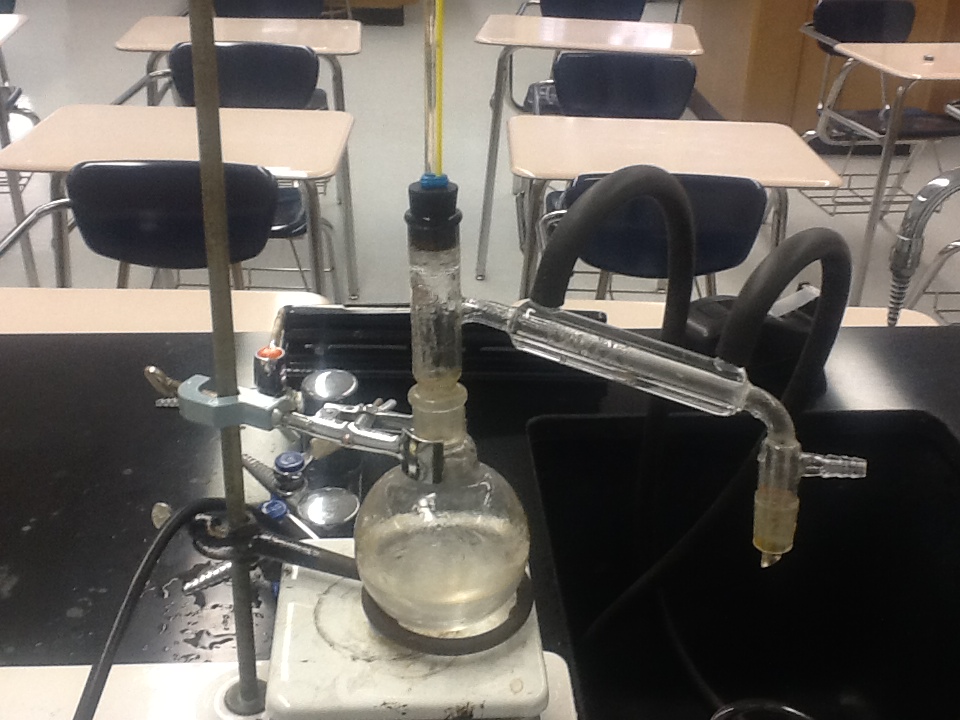
·         Explain separating compounds through Distillation by different boiling points
·         What is in rainwater that makes it acidic? CO2
·         Define CFC’s and what they do to promote global warming.
·         How does carbon dioxide affect global warming?
·         Hydrocarbon boiling points increase as the number of carbon atoms increase. Why?
·         What produces CO2 and what uses it?
·         What is carbon monoxide (CO) and how is it produced?
·         Define a catalyst. Is it used up in a reaction?
·         Define fractional distillation and what it’s used for.
·         How much garbage does the average person create per day? 4-7 pounds
·         What byproducts come from manufacturing processes?
·         Kinetic vs. potential vs. chemical energy
·         Why doesn’t an upside down jar lower into water easily? (air)
·         What does it mean to “use up” chemicals?
·         Altitude is related to pressure. High altitude = less pressure
·         Molarity is solution concentration
·         Kjoules measure energy
·         When we extract a metal from an ore, are we oxidizing or reducing it?


Tuesday, June 18, 2013

Honorable Mentions & How to make a page tab

a gif
On your new blog, learn how to get gifs (see above) and photos imbedded into your blog.
Also, learn how to make new pages with page tabs across the top. You want to post your terms and vocab words on a separate page. Go to Design, Pages, New Page, Name the page "Terms," save, and save arrangement. Also, click 'Show tabs in header.'

Today's honorable blog mentions are:
1. Jilly for her colorful blog background
2. Layla for her diagram of the hydrologic system
3. Merry for her creative story
4. Nora for creating the table shown below aggregating all our foul water data together. (And also for best pun: "It is clear that the carbon step made the clearest water.")
More honorable mentions:
5. Ricardo's drawing and Merry's drawing (see below)


Ricardo's distillation drawing

Merry's distillation drawing

(Who will win mentions tomorrow? Stay tuned.)
Nora's table of 6 lab groups' data for foul water
How can we explain Nora's table? Why did groups Boron and Carbon have less recovered foul water at almost every stage?


How does distillation purify foul water?
Explain the distillation process. How can distillation remove salt from salt water and give us pure, fresh water? How can distillation separate alcohol from water? What do the different boiling points of each liquid have to do with it? What makes liquid change into vapor or gas?


videos take time for blogger to process: post short videos (but not of students)

Thursday, June 14, 2012

Welcome to Chemistry, Summer 2013!

Welcome to Chemistry in the summer, 2013! Look forward to a challenging but rewarding summer of learning science--and exploring how it's increadingly relevant to today's world. Right away we will learn about water: it's structure and polarity (it has a positive and negative end), the relative downsides of water pollution versus water shortage. it's role as a solvent for so much of the world's compounds, how NaCl (table salt) dissolves in water (and what that means), and so much more. You will be studying Chemistry at both the atomic level and in the world around us. This should inform you as you move on through high school and beyond to make important decisions based on science.

I look forward to meeting you and teaching you. 

Sunday, July 31, 2011

Teaching ideas for next summer

Next summer, allow students to mess around hands on with mixing vinegar and milk, vinegar and Tums, to get a feel for acids and bases and the invisible world of chemisty

Monday, July 18, 2011

The Home Stretch

What to study by Wednesday
p191 Lab, Alloy table,
p337 electromagnetic waves, IR, uV
greenhouse gases, carbon cycle, global warming,
p212 petroleum refinery, distillation demo,
p219 hydrocarbon boiling points. electron shells, valence electrons are shared
p231
p238 energy of fossil fuels
p262 petrochemicals

Homework to be completed by Thursday! (so you can review)
#7-13 p204 unit 3 
#1-4 p344 unit 4 uV radiation vs. infrared, less dense atmosphere
#1-6 p350 unit 4 school bus emissions (YOU CAN SKIP THIS!!)
#14-20 p360 unit 4 frequency, spectrum, draw greenhouse effect
#1-30 p233 back to unit 3 petrol, covalent bond, SKIP THESE: # 2, 4, 9, 14, 24, 25
#31-38 p235 unit 3 alkanes, isomers, boiling points
#1-10 p258 unit 3 petrol, kinetic energy,
do these in your in head p279 unit 3  polymers,

Friday, July 15, 2011

Last Week (slightly modified)

6th and FINAL Week, JULY 18-22                                       SIXTH WEEK
Mon July 18
Tue
Wed
Thu
Fri
Practice Mini-quiz
rev. HW, SP, return tst

LAB: heating


HW #11)
Read Unit 4 B.1, B.2, B.7, B.11 p337
Answer Unit 4 BS #1-8 p360
ON Blog


Mini-quiz, rev. HW, SP

Lab on Antacid Test


HW #12)
Read Unit 3 A.1-A.3
Answer Unit 3 B.3 #1-4   p.344
SKIP Answer Unit 3 B.8 #1-6   p.350
Answer Unit 4 SBS #14-20 pg 361
Blog

Mini-Quiz, rev. HW, SP

Last blog in class, then revise at home: What was the best thing you got out of summer Chemistry? (one paragraph or so)


HW #13)
Read Unit 3 A.4 toA.9
Answer Unit 3 SAS #1-30
Except #’s 2, 4, 9, 14, 24, 25
Blog

v. short mini-quiz

 rev. HW, SP


Extra Credit Science Reports on Economist, science in NY Times, or TED talks


HW #14) Read Unit 3 A.10, 3 B.1-B.3, C.1, D.1-D.3, D.6
Answer 3 SAS #31-38
Answer 3 SBS #1-10
Answer in head 3 SCS #1, 3, 6, 13 and 3 SBS #11 and #12
Study for SECOND semester exam (Unit 1)
Last Blog


30 min. review, then
FINAL EXAM TEST ON SECOND SEMESTER (2 hrs) 9:-11: then nature film
11:30 dismissal

GRADES due Monday


Tuesday, July 12, 2011

Homework and Calendar

July 11 mquiz
METAL REPORT

Metal Report


______________
HW: Metal Report due Tue
July 12 mquiz
MOLES p161
Demo: Alkali Metal


______________
HW: Read C.1-C.6 p153
Answer 2SCS #1-12 p180
July 13 mquiz

______________
HW: Read C.7-C.11 p164
Answer Practice Sheets (handout)
Answer 2SCS #13-17 p181
Read LAB C.11 p169-172
July 14 mquiz
LAB: C.11 Retrieving Cu p168_____________
HW: Read C.12-C.15 p172 +  D.1-D.4 p184
Answer 2SCS #18-21 p182
+ 2SDS #1-6 p204
Finish lab report
July 18 mquiz

D.5 Lab Rpt due


_____________
HW: Read Unit 4 B.1, B.2, B.7, B.11 p337
Answer U. 4 BS #1-8 p361


July 19 mquiz
MODELING ALKANES LAB
DEMO Separate Distill


_____________
HW: Read Un3A.1-A.3 p212
Ansr Unit3 B.3 #1-4 p344 Ansr Unit 3 B.8 #1-6  p350 Answer Unit 4 SBS #14-20 p361

July 20 mquiz
Demo: Whoosh Bottle


_____________
HW: Read Unit 3 A.4 toA.9 p219
Answer Unit 3 SAS #1-30 p233 Except #’s 2, 4, 9, 14, 24, 25
Also Read Unit 3 A.10 p231, 3 B.1-B.3 p238, C.1, D.1-D.3, D.6 p282

July 21 mquiz


_____________
HW: REVIEW, STUDY
Study for 2nd semes. exam

HW: Answer 3 SAS #31-38 p235
Answer 3 SBS #1-10 p258
Answer in head 3 SCS #1, 3, 6, 13 p279 + 3 SBS #11 and #12 p258

Thursday, July 7, 2011

Metal Reports

Alexander


Al
Katrina


Au
Oliver


Fe
Chase


Mn
Mike Song


Li
Nia


Ag
Eden


Sn
Eva


Zn
Nicolai


Al
Dana


Cu
Rana


Fe
Camilla


Pb
Marcell


Ni
Adrian


Hg
Rebecca


Ca

Tuesday, June 14, 2011

Foul Water Lab

Foul Water Lab
To my Chemistry students:

Good job in class today, washing the glassware, sticking with the long lab, and working hard to make progress on your lab reports.
 --
Yours,  Dr Forman
Drinking the Foul Water

Here are links to some important sites:

Our Chem class website (for downloading documents):

If you click on important documents:

Then if you click on the PowerPoint for Lab Reports (it’s actually a document):

Also, here’s a question someone submitted:
Student: Why can't foul water lab make seawater drinkable? (p. 23) What process can? Is it because the foul water lab cannot completely remove the even smaller particles within the water?

Dr Forman: Filtration can't remove salt or other particles (like salt) in solution, but distillation can.

Wednesday, June 1, 2011

Create your own Chem blog

Plastic Lives
Create your own blog at https://www.blogger.com/start
(If you already have a gmail or Google account, sign in first at the top of the page with your user name and password. If you don’t already have a gmail or user account, click “Create Blog” and use your Buckley email address @buckleyla.org to create one.)
--Choose a name for your blog. (This will be your permanent blogging address).
--You may use your first name, but for internet safety reasons, don't use your last name, the name of the school, or photos of any students. 
--Choose a template design.
--Create a heading title. (Greets readers and stays at the top)
--Preview then Publish your blog.

--ADD INSTRUCTOR AS AUTHOR: Go to Dashboard, click Settings, click Permissions, Add authors, type in jforman@buckley.org and save.
--Add photo from Google images (search chemistry, science, etc.) and download pictures to myPictures in myDocs.
--When creating blogs, click the photo image (next to link) and browse to MyPictures and add.

Friday, May 27, 2011

Chemistry Themes to Remember

Priorities for the summer: remember big ideas long after the course is over.
1. How Chemistry fits into the Science family, what its role is, what it helps us understand.
2. Weigh in: Which is worse? Water shortages vs. Water pollution?
   Know the chemical properties of water that bear on these two issues. Debate online and in class. Inform yourself first. Have an informed opinion. Be able to argue either side.
3. Understand the Chemistry and issues around global warming and air pollution, including the chemical processes.
4. Have an understanding of the invisible world of matter underneath the 'surface.'
5. Know how the periodic table works and be able to describe the order that is natural in the world of matter.
Keep these themes in your blogs and thoughts throughout the summer and be able to discuss and debate them well.

Thursday, April 21, 2011